Showing posts with label Chanel. Show all posts

Tuesday, November 22, 2011

Tested Technique: Chanel faux bound buttonholes

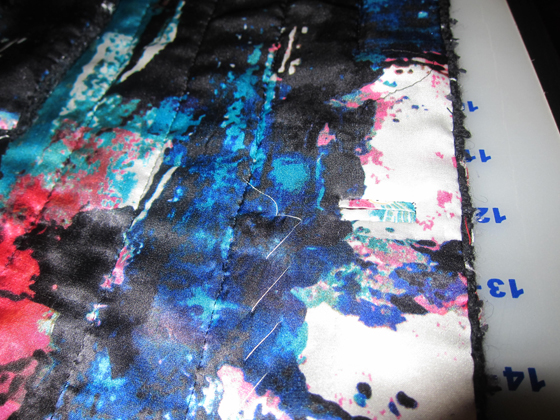
I made them because I wanted a bouclé cape with real buttonholes instead of the easier hook and eye. A hand-worked buttonhole is made on the face fabric (= bouclé), and a faux bound buttonhole is done on the lining, which extends to the edge of the jacket.
On the left, the hand-worked buttonhole (temporarily secured with a silk thread)
On the right, the faux bound buttonhole
Claire Shaeffer is the only one who describes this technique en detail - see the end of this post for available sources. So, I followed her instruction, changing a few things, which I thought made sense to me. Here I am describing how I did it. 

Time spent: appr. 30 min per buttonhole (2 hours in total)

Materials used:
  • silk thread for basting
  • polyester thread for permanent stitching
  • longer Japanese needles for basting
  • shorter Japanese needles for permanent stitching
  • Iron
Techniques:
  • running stitch
  • slip stitch
THE STEPS:

1. Prepare buttonhole welts


To prepare buttonhole welts, tear couple of 1 inch (2.5 cm) - wide strips of lining remnants on crossgrain. If your fabric doesn't allow tearing then cut on grain. 

I find that tearing the strips not only precisely establishes the grain, but also simplifies pressing and aligning of the strips in the following steps. 

You will need 2 welts for each buttonhole, and to establish the welt length use the following formula:

welt length = buttonhole length + 1" (2.5) seam allowance

Don't cut your stripes into welts yet, just use this formula to establish the total length you will need. it will save you some time. 

2. Press welts

Press your stripes to flatten the torn edge. Fold stripes in half, wrong sides together, and press them again. 

3. Cut welts


Now cut the welts in the required length using the formula above. 

4. Place the welts on the face fabric


It helps, before you do this step, to secure the hand-worked buttonhole on the face fabric (image above). This will minimize shifting of the fabric layers and allow you to align the welts faster.


Place the welts on the wrong side of the garment, with folds facing each other along the buttonhole centerline. It helps if the line is thread traced on the face fabric - it is usually done before the hand-worked buttonholes are applied. This thread-traced line should extend more than 1/2 inch on each side to serve as a guide. 


Using a small running stitch, permanently stitch the welts to the face fabric.

5. Finish lining

Lay the lining over the buttonholes and finish it. Usually, in this type of garment, where lining is quilted to the face fabric, it extends almost to the edge, and is finished using fell-stitches. 

6. Secure lining around buttonholes

Here you see how I basted around the buttonhole (from the right side of the garment) and, then, outlined the buttonholes lines (Step 7)
Before you proceed, you will need to secure the lining in place - this will allow you to cut the buttonhole with minimal shifting. To secure the lining baste around the buttonhole using a running stitch. Silk thread is the best, of course, since it doesn't leave marks on lining. 

This is where the easy part ends, readers. You will need to be extra focused 

7. Clip the lining 

As next, Claire Shaeffer advises to "carefully mark the ends of the buttonhole with pins and carefully clip between the pins, and another 1/16 inch at each end."

Be careful here! Since you basted the lining to the face fabric you have no control over the welts sandwiched in between, so, you have to be extremely careful about not clipping the welts accidentally. 

When  I did the trial buttonhole, I clipped the center line wrong, so it was off. With the next buttonhole, I used an air-erasable marker to draw the center line and the outlines.

8. Finish the buttonhole


To finish the buttonhole you will need to carefully turn under the buttonhole edges appr. 1/8 inch from the centerline and slipstitch the folded edges to the welts. This is probably the most demanding step as it requires very accurate folding and stitching. 

I would recommend using a smaller hand sewing needle and going around the buttonhole twice - this way you don't have to make too tiny stitches. Claire Shaeffer also recommend using needle point to shape the buttonhole corners. 

By the way, you can see that my buttonhole welts are wider than 1/8 inch. I just thought this would work best for me, mainly because I used relatively large buttons, so the buttonhole length is slightly more than an inch. I think solid color would look better with narrower welts. 

It is virtually impossible to achieve perfect rectangular shape with charmeuse, because it is so slippery and frays the moment you touch it. Now, I think fusing around the lining around the buttonhole may help control the silk. However, with silk, I would be extra careful about it and make a sample first. I would also secure the corners with a couple of narrow overcast stitches, because those sections are under the stress every time you (un)button the jacket.


So, that's it readers! 

Am I happy with the outcome? 

Well,  I wish the result was better, but then I looked at pictures of vintage couture Chanel jackets available on Shaeffer's DVD "Behind the Seams: Shaeffer on Chanel". Readers, hand-worked buttonholes look better than mine, but not better than Jefferey D.'s. However, the faux bound buttonholes are often a mess, at least judging by those pictures - I think, with some experimenting it is possible to achieve better results. 

The verdict:

Shaeffer's technique is the most suitable technique for bouclé jackets. Finishing part is really awkward, but if you are a patient person and don't mind going slowly about it, you will get quite good buttonhole. 

Some tips on how to make it look even better:

Mastering hand-worked buttonholes is important for the overall outcome. However, I also realized that bouclé hides a lot of imperfections. Choosing silk thread for the face fabric will blend threads even more. Using quality beeswax helps as well, as the thread will look less dull. 

With the faux bound buttonholes, I thought that print charmeuse (instead of the solid color) is more forgiving, especially if it is an abstract print like mine. 

Finally, applying some pressure to the buttonhole with the tip of an iron makes it look better.

As for the cape, it is now finished, yay! I may also apply chain to weight it in front, because it pulls back slightly, maybe because of the heavier slit on the back. I am still not decided on it... Will be posting the pictures of the finished cape this week, readers!

Here are some sources I used as a reference:

V8259 - highly coveted jacket pattern by Claire Shaeffer Custom Couture (inspired by a strikingly similar vintage couture Chanel jacket). Construction technique include quilting and a three-piece sleeve.
"The Comfortable Side of Couture: Practical Techniques of Coco Chanel" by Claire Shaeffer in "Great Sewn Clothes", Threads publication - describes construction techniques of a typical couture Chanel jacket
"The Comfortable Side of Couture:Practical Techniques of Coco Chanel" by Claire Shaeffer in Threads Magazine Archive, Issue 23, June/July 1989
"Behind the Seams: The Shaeffer Collection" by Claire Shaeffer and David Page Coffin, 2009 - a collection of images documenting construction of Chanel Haute Couture and RTW garments.

What about your buttonholes? Have you tried buttonholes on bouclé, or any other loosely woven fabrics. I am wondering what other options are there... as always post links to relevant posts, projects, tutorials!

Tuesday, October 11, 2011

Bouclé, Charmeuse and Quilting à la Chanel | Part 3


This is the final and the easiest part, readers! Today I will show you how to quilt the lining and bouclé for your Chanel-inspired garment. All the prep work is behind us, can you believe it?!

This part will take you an hour or two depending on how complex is your pattern. It took me an hour to quilt my 8-piece cape, and another hour or slightly less to clean up the thread ends and make tiny corrections. 

In the previous part we prepared our garment pieces for quilting and the layers of lining fabric, organza interfacing and bouclé were pinned or tailored-basted together. We took a break, good for keeping up your mojo high in non-sewing class conditions.

What you'll need now is:
  • Walking foot for your machine to make sure there is minimum shifting of fabric layers during quilting. (if you don't have a walking foot I would baste the layers together along quilting lines - this will cost extra time though)
  • For stitching, preferably silk floss, mercerized cotton, or embroidery thread (but polyester thread would do as well, actually)
  • Microtex needles. I am recommending a microtex needle for bouclés that have novelty threads, lurex etc inside - those are very nasty with a regular needle. If your boucle doesn't have those, you are fine with a Universal needle, but make sure the number is a compromise for bouclé and silk combination. I am sewing with #70 Microtex. 

STEP 1

Stitch along marked quilting lines! As easy as that! Leave your thread ends long, so you can tie them off comfortably (Step 2). 


A word of caution: do look where you start and finish - your quilted lines must start and end 1" (2.5cm) from the closest stitching line. We will need that space to accommodate seam allowances once your garment is assembled. 

Another word of caution: Don't backtack! I will show you a better and tidier method of securing your stitching lines in the next step


STEP 2


Remove pins or basting and give your quilted pieces a light steam press, using silk organza press cloth. Don't overpress it - just a light touch with a little steam would be enough - you don't want your bouclé look like pressed towel. 


loose thread ends
Fold back the edge portion of the lining to expose the end of the stitching line


Pull the thread ends between your fashion fabric and lining layers

I am not cutting it, just pulling the thread gently. You can also use a pin to help pull the thread.
both threads ends are between the layers
Tie off the thread ends and trim them. In her Thread's article "Inside a Chanel Jacket", Susan Khalje recommends using a stronger and more durable jeweler's knot to tie off the thread ends. To tie the know really close to the last stitch use a pin. 

First, make a knot loop using your fingers (as you would normally do it), but before you tie it off, place a pin inside the loop. 


Pull the thread with the pin inside the loop and move the pin as close to the last stitch as possible. Remove the pin, voilà. 

However, if this is too complicated, or if your thread ends are too short to make a jeweler's knot, use your regular double knot, just try to get it as close to the last/first stitch as possible. 

That's it! Finita la comedia! Farce is over, readers!

QUILTING AND SHRINKING

After I made my Chanel-inspired jacket, some of you asked me whether the garment pieces shrank after quilting. No. There was no shrinking. Shrinking is likely to happen if you quilt excessively, but with vertical lines every 1" or so, you should be fine. If you are not sure, however, do compare the quilted pieces to your muslin, or original paper pattern and adjust stitching lines, or any other markings accordingly.

NEXT STEPS

For my cape, I will be putting the pieces together as a next step. I am not sure how much interest this posts generate so I won't be making another tutorial for the assembly. But do let me know if you are interested. 

A new thing for me would be Chanel buttonholes. I must admit that I have never made hand-worked buttonholes, which scare  me a lot. And this cape does ask for some nice buttons, but that's a whole new story!..

If you missed previous parts of this tutorial, here are the links: {Part 1} {Part 2}. Also, check out my other tutorials and tips.

All the resources I used or referenced in this tutorial are listed in the Part 1. However, in my opinion, Threads Archive is the best resource for most of the techniques I use in my sewing, so if you can, do get a hold of it. Here is the link on Threads website. 

Now your turn, readers! Have you quilted bouclé before? Any tips, experiences you want to share? Do you think this technique is functional or just a gimmick?.. 

Wednesday, October 5, 2011

Bouclé, Charmeuse and Quilting à la Chanel / Part 2


Are you ready, readers? We are about to start with one of the most interesting sewing techniques, widely used by Chanel in her couture jackets.

Ok, I have told you before, I split this tutorial in several parts and this is Part 2 of 3, where we will cover cutting the lining and preparing it for quilting.


I have structured this tutorial so that each part needs to be finished in one session. Once you start this part you won't be able to remove your silk lining until it's pinned to the fashion fabric. So, depending on how fast you work, you will need two to three hours to complete this part. It's not difficult, really. 

BEFORE YOU START, make sure...
  • your fashion fabric is cut with 1" to 2" seam allowance (2" seam allowance is only necessary if your fabric frays like crazy; 1" is good for more stable weaves)
  • individual pieces are thread-traced
  • lengthwise grain is marked on all cut pieces. (you can skip this for plaids and stripes, just make sure you know which lines follow the lengthwise grain, as opposed to cross grain)
  • finally, have your (improvised) pattern weights, transparent ruler and silk pins ready! 
  • and, you will also need appr. 1/2 yard (slightly less than 0.5m) of silk organza, or equivalent amount of organza remnants for interfacing (more detailed instructions are below)
ADDING INTERFACING

I suppose, you have your silk organza ready? Sorry, why silk organza? It doesn't add bulk, and it is great for stabilizing and interfacing. Actually, feel welcome to contribute your ideas on silk organza while I am getting on with the tutorial.


I am using this huge triangle of silk organza from the times when I thought that making 1 yard of bias tape requires cutting a yard of silk organza into two triangle pieces and using only the longer  strips. What a waste! I really learned it hard way. Luckily, I did not throw the 'useless' triangle away. 

Why interfacing?
On my cape, I need to interface the top sections from my shoulders to approximately breast and shoulder blades level. I am doing it on all, front and back pieces. On my Chanel-inspired jacket I interfaced only the front, but here, the cape is not fitted, and it has a lot of fabric hanging from shoulders, which will carry all this weight and stretch over time. So, to avoid any future distortion on the upper portion of the garment, I decided to interface all pieces. 

How much?
The height of the interfacing piece is approximately the distance from shoulder line to the bust. The width will depend on the pattern piece.

So, if you are using a pristine piece of silk organza, just tear off two stripes, the width of which will be equal to your shoulder-to-bust measurement plus 1" seam allowance.


please, press your stripes before attaching them to fashion fabric!
Inserting interfacing


Disclaimer: I initially forgot to add interfacing. So, this image was in fact taken after the lining was cut. But it is much easier to do this step as in the tutorial - before the lining is cut - saves extra 15 min of your time.
Now, take your thread-traced pieces and pin organza to the top portion aligning the crosswise grain. If you have a plaid bouclé, just align the torn edge of your organza strip with the crosswise line of the plaid. Pin to seam allowances. Cut excess fabric. Baste along the seamlines.

Voilà!


PREPARING and GRAINING LINING FABRIC

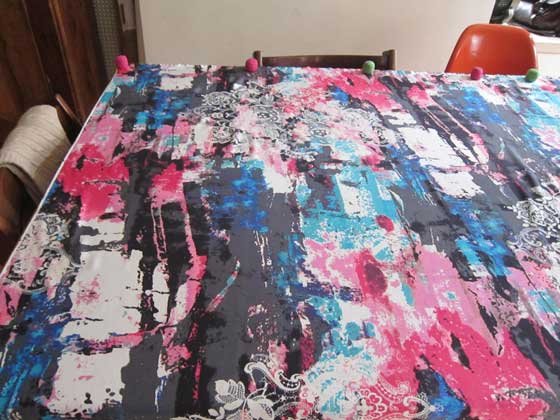
I use a larger table to cut lining. My silk charmeuse was torn at cross grain, which gave me a pretty accurate guide for aligning the fabric. 

Tearing fabric along cross grain saves time required for graining. But you may ask, whether your (woven) fabric will respond well to it. Well, try to make a test. Cut a small nick in the selvedge, just where you would want it to be cut, and rip the lining gently. If it works well than you are fine. Otherwise, especially with very fine fabrics, you will need to pull out a thread from one edge to the other and cut along the gap line. 

Lay out your lining on a rectangular table, face down, aligning the cut/torn edge and one selvedge along two adjacent table edges. Of course, a cutting mat is perfect for this task, but you can also do without it.


You may now discover that, when  you lay out your charmeuse, or other silk lining, the non aligned edge of the lining behaves weirdly: pulling fabric, or not forming a perfect straight line. In this case, the culprit is the selvedge. Try cutting off the selvedge on both edges very carefully (just for the portion that you need to cut your lining pieces from). This should solve the problem.

Align your lining fabric along table edges again. Secure it with small pattern weights. 


LAYING OUT PATTERN PIECES

The most important thing here is the Grain! This is probably the most time-consuming and boring step. I hate this step and get anxiety attack every time I have to do it. So have a chocolate and put on some cheesy music. Think that once you are over with it the rest is super easy, really. 

1. Lay out fashion fabric pieces on lining
So, your lining fabric is laid out face down on the cutting table. You will now lay your cut fashion fabric pieces - not pattern pieces - on the lining fabric, face up. The reason is, that, once the layers are aligned and grained, we will just pin seam allowances together, and cut. Pins will hold the two layers together until they are quilted and ready to be assembled. 


2. I Will Measure, Yeah, Measure


When laying out cut fashion fabric (face up!) on lining fabric, all you need to do is think about the Grain! It must be already marked/thread-traced on your fashion fabric. Take your 2"-wide transparent ruler, and measure the distance between the silk lining selvedge (or the silk edge) and the grain line. I usually measure at the bottom of the grain line, then in the middle, and finally, at the top. If the piece is short, measure the distance only at the top and at the bottom. The distance to the edge should be the same along the grain. 


Carefully pin along the grainline of the aligned fashion fabric piece to join it with the silk lining. Try not to move fabric.

If your next piece is further from the edge of the lining fabric, measure distance to the grainline of the closest piece that had been already aligned.

3. Pin
Once you laid out all pieces on the grained lining, pin seam allowances, and cut the lining along the cutting edges of the fashion fabric pieces. 

4. Cut
Carefully remove the cut layers and put them on a flat surface.


5. Répétez s'il vous plait!
If you were not able to accommodate all pieces at once, you may need to repeat this step for the remaining lining. 

PREPARING FOR QUILTING

You will need: chalk marker (white), ruler, pins (or basting needle and thread), walking foot.

If you googled Chanel quilting, you may have found out that you can quilt lines, squares, trapezoids, circles, animal shapes... basically anything, as long as it follows the pattern on bouclé.

Now, dear sewing nerds! I mean, sorry, you are sewing nerds if you didn't give up on this tutorial! Dear sewing nerds, be disappointed, quilting vertical lines is absolutely sufficient to fulfill the function of quilting. Unless, you do want to torture yourself!

If your boucle pattern has defined vertical lines, you will quilt along those lines every 1" (2.5 cm). It is ok if the distance between lines is slightly wider or narrower.

If you are sewing with solid bouclé fabric, you will need to mark on it vertical lines, 1" apart, using a chalk and a ruler.

The lines start and stop 1" (2.5 cm) from the closest seamline! Use a marker to mark the starting and the ending point of your quilting line.


Now, let's STABILIZE FABRIC LAYERS....

... (a) MASOCHISTIC WAY


... using tailor basting to secure layers between your future quilting lines. This is a great method to conclude a very stressful day - some monotonous hand sewing! Add incense sticks, esoteric music and wait for that portal to open... 

... or (b) SANE WAY


...just pin between the lines, but please straighten the lining underneath your fashion fabric before!

Lay your prepared fabric flat until you are ready to quilt!

MAJQA, readers! Which is 'well done' in Klingon. Please, forgive me for any infantile statements - I am still sick!

Questions?

Monday, October 3, 2011

Bouclé, Charmeuse and Quilting à la Chanel


Ok, my quilting tutorial is an epic. Again. 

I somehow manage to produce annals on simplest things. Give me a catchstitch and I will return it with a PhD-worthy manual.

The same is happening here. And before I overload you with details, check out this quick intro on what you will need to quilt your bouclé à la Chanel.

How did I learn these techniques? First by reading Claire Shaeffer articles, book and instructions for her highly-coveted Vogue#8259 Chanel Jacket, which I was very lucky to find. I also took a Classic French Jacket Class with Susan Khalje, and the techniques I learnt there were very similar to those I learnt myself, but nothing, of course, can replace face-to-face learning experience. 

I am now working on my Colette Fall Palette cape, which I decided to make from a nice black and white even plaid bouclé I bought at Mendel and Goldberg. The cape is lined with printed silk charmeuse from Mood Fabrics. It was only natural to make it following Chanel techniques, instead of following Burda instructions, because I wanted to have a piece that feels luxurious, soft and warm, and, at the same time, a piece that would last longer. 

Techniques you will find here are a mix and modification from classes, publications and pattern instructions, see the resources at the end of this post. At the end of the post, you will find links to resources that go into depth about quilting. 

Ready?


FABRICS? OR, WHY I AM QUILTING…

I bought relatively loosely-woven bouclé for the cape. I (now) know that, after a while, some portions of the cape will sag if I don’t stabilize it. This will happen mostly to the upper part of the garment, since it carries the most weight. Excess fabric will show at the bottom part which will look like a bubble... 

So, the action plan is: quilting lining to boucle, and adding a layer of silk organza on the upper portion of pattern pieces as an interfacing - to further stabilize the fabric and the seams without adding bulk.

Here is what I am using for my project:
  • Wool bouclé 
  • Silk Charmeuse Lining – silk charmeuse is a very good choice for warmer garments. However, there are more choices for silk linings - I discussed some of them in my Burda Style guest post.
  • Silk Organza for interfacing. 

Got scrap organza? Never through away remnants of organza, or organza selvedge!!!! Never!!! You will need every square inch! Bigger pieces (5 to 10 sq. in.) are good for interfacing the area around armscye. Smaller, literally 1 sq. in. pieces, are great for interfacing buttonholes and button areas.


TOOLS & NOTIONS:
  • 2"-wide transparent ruler – is a must, since makes life so much easier 
  • WHITE chalk markerpen-style Clover chalk liners are the best I have tried. Never use yellow! It will leave permanent marks on your fabric.
  • Finest silk pins – you don’t want to leave marks on your precious silk
  • Japanese hand basting needles – for thread-tracing and basting
  • Silk thread in contrasting color for hand basting and thread tracing. Pulling out silk basting is much easier! 

QUILTING IS DONE BY MACHINE, and you will need…
  • A walking foot – you will struggle without, but still can try if you want on a scrap.
  • Silk floss, machine embroidery threador mercerized cotton for machine-quilting
  • Microtex needle - I am using Microtex because it works best with both, silk and bouclé, which often contains some novelty threads (Universal needle just could not pierce through the latter without breaking thread). #70 works great


RESOURCES:

As promised, here are some resources you may want to explore in addition to the upcoming tutorial:

Claire Shaeffer. The Comfortable Side of Couture: Practical techniques of Coco Chanel. First published in Threads Magazine, June/July 1989, Issue 23. Republished in The Best of Threads: Designer Techniques, Spring/Summer 2011 (Thread Archives contain several Chanel-related tutorials and articles by both, Claire Shaeffer and Susan Khalje).

Claire Shaeffer. Couture Sewing Techniques:Revised & Updated. Chapter: Applying Couture Techniques: The Quilted Lining (p. 195)

Vogue Patterns # 8259. Chanel-inspired jacket. Custom Couture by Claire Shaeffer. Here, the quilting is slightly different then in the other sources, but the pattern has great step-by-step instructions and the highly-coveted three-piece sleeve.

For hands-on experience, join Susan Khalje’s class Classic French Jacket, usually in Baltimore, MA, or Claire Shaeffer class in Palm Springs, CA.


Part II of the Quilting à la Chanel will include: 
  • Laying Out & Cutting Lining.
  • Adding Interfacing.
  • Preparing Layers for Machine-Quilting. 

I will post the second part on Wednesday - at the moment both, me and my 2-years old are still sick, so tomorrow a lighter treat:  trend report inspired by this week's Sew Weekly Challenge: Spanish Harlem.


That’s it for today, readers! Questions?


Sunday, October 2, 2011

NYC Sew Weekly Meetup & Blogtober Fest #2

By the way, did I tell you how much I loved this Friday? Despite having caught some nasty cold with earache and sore throat.

Yes, fabulous Sew Weekly girls organized a meetup in NYC. See yourself:

Group photo at Paron's {thanks Oona!} 
Dinner at Room Service, featuring Debi from My Happy Sewing Place

Meg the Grand, voila
Now, I wish I could give you an extensive account of what happened during the day, which  was packed with events, including lunch, pattern swap, fabric shopping (yay, I finally got lining for my cape), and, finally dinner... But I was just able to join for an hour at lunch and then have dinner with the girls...

All the present bloggers are on my blogroll, so check it out. And if you were wondering about the progress of my Colette Fall Palette, I do have something to report:


If you can follow the red thread on bouclé, yes, it is thread tracing and on the left is the lining I liked and could afford - it's printed silk charmeuse and at this moment it is already cut and pinned to bouclé pieces, ready to be quilted.  And I got a little treat for you tomorrow, quilting tutorial, based on Chanel couture techniques. It is really easy, and not that time consuming - stay tuned!

And, so, it was Blogtober Fest post #2.

Thursday, September 1, 2011

Back to Chanel... now with a skirt!

Remember my Chanel-inspired jacket?


Now it's time to finish this chapter by addressing the skirt, won't you agree, readers?
The thing is, I have almost two yards (got to check, actually) of the same boucle left... How could it happen? Well, I bought end of a bolt and got a good deal for this very generous amount of bouclé!

Ok, back to skirt! I must admit, I am tired of pencil skirts, and this is a welcome opportunity to do something different. Well, not VERY different... To be precise,.. look at this image from Chanel Fall 2011 RTW show...


Source
So, I do want to have a continuous line running at the center front through the jacket and the skirt. I have only couple of flowers left from the trim, so I would need to find a solution for a coherent look, but I think I can come up with something.

I am not in a rush, so this skirt will be going along other sewing projects, one step a week. Obviously, I will start with a muslin (I will need to match and I want to cut the fabric knowing that I won't need to make any alterations). Then, there will be quilting, shaped waist, lining clean-up etc. I will be posting the progress here.

If you have never worked with boucle using Chanel-inspired techniques - this is a great project to test your patience! And if you are up to it and want to have a sew-along, I will organize this accordingly. If not, it will be a loose progress report :-)

D'accord?

Sunday, June 5, 2011

Classic French Jacket Class: Day 6 (the Finale)

It's my last day, or half a day, to be precise. Tomorrow, I need to get back to work, and so, I need to be back in New York this evening. 

it's 9:00 a.m. I am back to the classroom and join my classmates who are busy finishing their jackets. I am  taking a bus to New York with Rosie today and need to accomplish as much as possible by 2:00. When I try on my jacket, Susan point outs that both center front edges are a little bit too long. I have to take in 1/4" on both ends of the hem. Not happy about another alteration, but I want my jacket to be as perfect as possible, so I unpick, alter and clean up the hem. Also managed to attach another trim section - did I tell you that I didn't have enough trim to run all the way around the jacket hem - M&J had some 3.5 yards only. Finally, on Day 5 I found a way to place it so I had enough. I bought some more needles, pins and sleeve pads from Susan and am now off to pack my bags.


12:00 p.m. I am back with bags. I have accumulated an additional bag over the week - how does it happen?.. Meanwhile, Rosie is checking out pockets on her jacket. Are these pockets supposed to be functional?


12:30 p.m. Before we leave, Susan shows us how to choose and apply the chain.  Rosie's jacket gets a golden chain, while I pick a silver one.


This is a chain from the jacket featured in Threads Magazine, Issue 121.
See, how each link is secured twice with a double-strength waxed thread!

Susan gives us additional tips on how to make a grosgrain waistband for a matching skirt. She points at a section in her Linen and Cotton book, where she describes in detail the technique. I am happy I got the book (it's one of my favourite reference books on couture sewing, by the way).


2:00 p.m. just before we leave I take this picture of Peggy's lining. Isn't this fabric gorgeous?


2:30 p.m. Our cab has arrived and everyone helps to carry a bag. We get apples to eat on the way home -  hugs and promises to exchange pictures of finished jackets!

On the way, I am thinking of what else needs to be done until the jacket is finished:

- resew the hooks (yes, again, because I was too lazy and stabilized the eyes only)
- finish the hem
- clean-up the remaining sleeve vent
- attach the trim
- attach the chain
- final press (steam only)

Once in New York, I give Rosie a big hug, while she promises to take me to a new dumpling place in Midtown, where we both work. It feels like a new stage in my life and it's very welcome.

Now, back to you, dear readers. I still owe you images of the finished jacket - please give me another day  - right now my face is red, and my nose is swollen from the flu that doesn't seem to end. And I would like to model the jacket for you!

And, finally, there is another, final post on this jacket and the class that will come some time this week to summarize the experience and to share with you a few great tips from Susan! But more about it later!

(to be continued)

Friday, June 3, 2011

Sewing Gadgetmania: Walking foot and why you need it for sewing a Chanel-inspired jacket


This Gadgetmania post is also a part of my Classic French Jacket class project, for I am featuring here a walking foot – an essential tool for quilting the lining and the fashion fabric in a Chanel-like jacket. (I am still sick, by the way, so forgive me any incoherence here) 

What makes this foot special is that it has its own feed dog to move the top layer of fabric. Usually, we would use only the machine’s own feed dog that moves fabric layers from underneath only.

It’s only logical that with slippery fabrics (like charmeuse, or crepe de chine used in Chanel suit lining), the upper layer would shift without additional feed. If you use a walking foot, both layers are moved at the same rate, preventing puckering and pleating of the fabric. 

I have never heard about the foot before the class, and thanks to Dawn (she was my classmate in the Classic French Jacket Class) I am now using it for all my silk / slippery fabric projects!

Prepare paying some $60 to $140 for this tool. And, beware, the ones available for less on eBay are often not original ones, so read the description carefully. (I am not sure they are bad - but I always try go for original tools if they are a little more complex than a sewing needle)

I am featuring here my Bernina foot, but there are quite a few other brands available on the market. Just check the website of your sewing machine manufacturer for the available accessories. 

Have you ever tried sewing with a walking foot? What other non-beginner, or relatively rare tools are you using in your sewing?

Thursday, June 2, 2011

Sneak peek of my Chanel-inspired jacket

Dear readers, I am having the flu (so annoying!) and won't be posting much today. But to compensate for the lack of posts, I am offering you a sneak peek of my finished jacket! Voilà!


Stay tuned for the Day 6 and detailed images of the finished jacket.

Wednesday, June 1, 2011

Classic French Jacket Class: Day 5 (or why it takes 17 hours to set-in the sleeves)

8:30 a.m. I am already in the classroom – the classroom is almost full again. It’s my last full day and I still have to accomplish a lot.

Yesterday, I finally booked my bus back to New York. Rosie, with whom I will be travelling, insisted I do it because ‘Amtrak is just so unreliable’. I gave in and followed her instincts.

Today, I plan to finish the sleeves and the jacket hem, which is currently pinned every half a centimetre. I also want to finish the jacket edges and start sewing on the trim. The sleeves, however, will take up most of the time.

Remember, I told you that it takes seventeen (17) hours to insert sleeves and finish them? Here is the breakdown of the steps, so You know what I am talking about:
  • Make a muslin for the sleeves.
  • Fit the muslin, make necessary alterations
  • cut the fashion fabric and the lining
  • quilt the lining to the fashion fabric
  • clean up the sleeves and finish the vents
  • insert the lower part of the sleeves (by hand!)
  • fit the upper part of the sleeve on the body, pin it, and finish inserting the sleeve by hand.
  • Finish the sleeve seam allowances and cover them with the lining fabric (by hand, again)
  • Try the jacket on  to determine the sleeve length and finish the sleeve hems.


the upper portion of the armscye still has to be fell-stitched
By 2:00 p.m. I was able to finish all, but the last step of the sleeve

Susan quickly explains how to sew on hooks and eyes (I am not using buttons, because my trim is rather opulent) and how to attach the trim.

03:30 p.m. …after sewing eight hooks and eight eyes…. They are loose – I have to resew them

04:00 p.m. …still loose… Are they sliding out, or what?!  I have reinforced them everywhere!

04:30 p.m. Loo-oose!!!!

05:00 p.m. Damn! I cannot believe it! I went through the entire jacket construction epic without a major glitch, and am now failing at sewing on hooks and eyes?

Dawn, another class participant and an extremely helpful and resourceful person, suggests using silk organza to reinforce the loosely woven bouclé underneath. Did I tell you I had to open the edges of the jacket to resew the hooks & eyes?  Anyway, organza helps!

12:00 p.m. I decide to take the remaining work to my room, but, then, fall asleep in my bed while fellstitching the jacket edge again.

This happened because I wasted two hours complaining about my trim. My eyes are tired of looking at it and I have my doubts… I thought it was too dressy – and I wanted to wear it frequently. Shall I use fringed selvedge and chiffon strips instead?.. finally I am able to make a decision!

(to be continued)

Tuesday, May 31, 2011

Classic French Jacket Class: Day 4 (epic sleeves)

Summary:
Sleep: 5 hours
Meals skipped: none, yay! (I thing it was related to my happiness level, see below)
Happiness level: ........  I tend to eat more when my happiness level sinks...

Did you know that it takes freaking 17 hours to complete sleeves for this jacket!!!!! Now I know what Susan meant when she said we would freak out if we saw the instructions before the end of the class.

9:00 a.m. I am in the classroom, cleaning up and fell stitching the seams on the sleeves. This is a three-piece sleeve. One seam runs as an extension of the shoulder seam, and two other under the armpit, so the vent has a very pleasing placement.

11:00 a.m. fell-stitching...

12:45 p.m. Still fell stitching....

Susan's tip: use pins as a stitch: insert a pin at the very edge of a fabric fold for very accurate marking


My sleeves are quilted as well, and we are waiting for instructions on the sleeve vent.

01:45 p.m. Susan shows me how to handle the vent and sends me back to my table to finish up the other.


06:00 p.m. Still working with the sleeves. Susan tells me to finish all the remaining work to prepare the sleeves for fitting.

11:00 p.m. I am done with my homework, but decide to stay in the room and keep company to my fellow couturiers and work on other things.

01:00 a.m. I am exhausted  - time for bed. It seems there is no end to these sleeves. I am so looking  forward to the next step. Today, I worked 12 hours on sleeves only....

(to be continued)
 
Fashion Design © 2012 | All Rights Reserved | About | Privacy Policy | RSS Feed